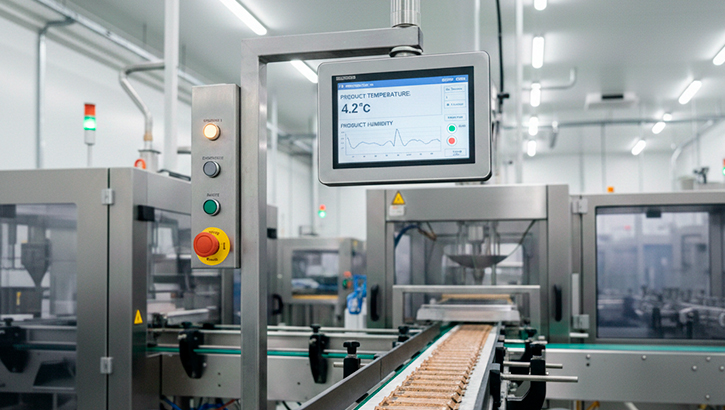
n the food industry, quality is non-negotiable. Every batch produced must meet strict standards of safety, traceability, and consistency. In this context, smart sensors and real-time monitoring, powered by IoT (Internet of Things) technology, are revolutionizing how production plants manage their processes.
Today, industrial machinery no longer just performs tasks: it collects data, analyzes it, and takes action before problems arise.
What is industrial IoT in the food industry?
The Industrial Internet of Things (IIoT) involves integrating sensors, devices, and systems connected to a network that collect and share data in real time. In a food processing plant, this might include:
- Temperature and humidity sensors in ovens and cold storage rooms
- Pressure sensors on packaging lines
- Vibration detectors on motors and conveyor belts
- Flow meters in dosing systems
- Machine vision systems for quality control
All these devices are connected and send continuous information to a central platform, where the data is automatically analyzed.
A line equipped with smart sensors not only produces: it learns, adapts, and prevents problems before they affect food quality.
Early detection of problems: anticipating instead of reacting
Traditionally, many plants operated under a reactive model: a problem was detected only after a quality deviation or mechanical failure had already occurred.
With smart sensors and real-time monitoring, the approach changes completely.
1. Precise control of critical variables
Small variations in temperature or humidity can affect the texture, flavor, or safety of the product. Sensors allow for:
- Detect even the smallest deviations
- Activate automatic alerts
- Adjust parameters instantly
This prevents an entire batch from falling out of specification.
2. Predictive maintenance
Vibration and performance sensors in engines allow for the identification of abnormal patterns before a breakdown occurs.
For example:
- An unusual increase in vibration may indicate bearing wear.
- Changes in energy consumption may indicate friction or overload.
Thanks to data analysis, the system can recommend technical intervention before the machine stops unexpectedly.
Result: less downtime and a longer equipment lifespan.
3. Data analysis for continuous improvement
Real-time monitoring doesn’t just detect faults. It also allows:
- Analyze production trends
- Optimize cycle times
- Reduce waste
- Improve energy efficiency
The information gathered becomes a strategic tool for decision-making.
Key benefits for food companies
Implementing IoT technology in industrial machinery offers clear competitive advantages:
- Higher product quality and consistency: continuous monitoring of critical parameters.
- Waste reduction: fewer out-of-specification products.
- Regulatory compliance and traceability: detailed digital record of each phase of the process.
- Immediate response to incidents: automatic alerts and real-time action.
- Optimization of operating costs: less corrective maintenance and greater efficiency.