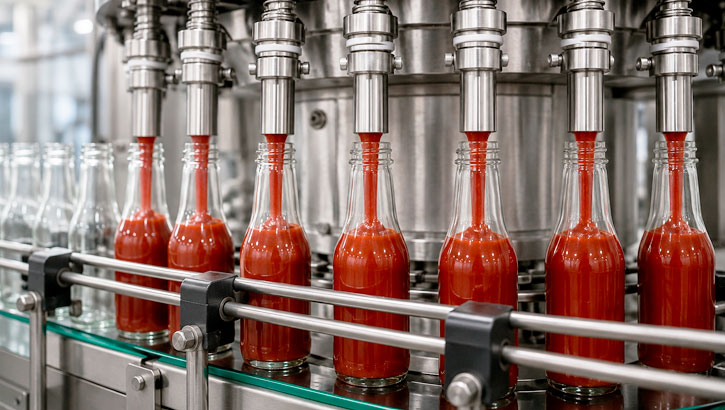
In the modern food industry, the production of sauces and creams demands an ever-increasing level of precision. The demand for homogeneous, safe products with consistent flavor has made the automation of ingredient dosing and mixing a strategic element within processing lines.
In this context, process engineering and specialized equipment enable manufacturers like Serrano Foodtech to design solutions that ensure consistency, reduce production times, and minimize human error, guaranteeing repeatable results batch after batch.os repetibles lote tras lote.
The challenge of formulation in sauces and creams
Sauces, emulsions, and creams are technically complex products. Their preparation involves the precise combination of multiple ingredients:
- Liquid phases (water, oils, vinegars)
- Viscous ingredients (tomato paste, purées)
- Powders (spices, stabilizers, proteins)
- Additives in small doses (emulsifiers, preservatives)
The main challenge is not just mixing, but maintaining product stability, preventing phase separation, and ensuring a uniform texture.a textura uniforme.
Any variation in dosage may cause:
- Changes in flavor and color
- Emulsion instability
- Differences in viscosity
- Loss of quality between batches
Automation in the dosing and mixing of ingredients is not merely a technological upgrade, but a competitive necessity in the sauces and creams industry.
Automation: millimeter-precise accuracy with every ingredient
Automated dosing systems allow for the precise control of each component of the recipe. This equipment includes:
- High-precision flow meters
- Volumetric or gravimetric dosing pumps
- Integrated weighing systems
- Hygienic automatic control valves
- PLC controllers and recipe management software (batch control)
Thanks to this technology, each ingredient is incorporated in the exact programmed amount, eliminating the variability associated with the manual process.
Industrial mixing: guaranteed homogeneity
Once the ingredients have been dosed, the mixing process is crucial for achieving a uniform and stable texture. Modern industrial equipment enables:
- High-shear mixing for fine emulsions
- Low-speed agitation systems for viscous products
- Tanks with integrated temperature control
- Vacuum mixers to prevent oxidation
The result is a homogeneous structure that retains its properties during storage and distribution.
Key benefits of automation in production
The integration of automated systems into dosing and mixing offers significant advantages:
1. Product consistency: Each batch maintains the exact same flavor profile, texture, and viscosity.
2. Time savings: Automation reduces preparation times, manual loading, and between-batch adjustments.
3. Reduction of human error: Inaccuracies in weighing, measuring, or adding ingredients are eliminated.
4. Raw material optimization: Waste is minimized, and the overall formulation yield is improved.
5. Full traceability: Every ingredient is recorded, ensuring control and food safety.
Digitization and control of prescriptions
One of the most significant advances in this type of process is the digitization of industrial recipes. Through SCADA systems and production management software, it is possible to:
- Program complete recipes automatically
- Adjust parameters in real time
- Record each batch produced
- Perform production audits with real-time data
This not only improves efficiency but also facilitates regulatory compliance and quality certification.
Application in the sauces and creams industry
Automation is particularly relevant for products such as:
- Mayonnaises and cold emulsions
- Tomato sauces and culinary bases
- Vegetable- and dairy-based creams
- Ready-made sauces for foodservice
In all these cases, product stability depends directly on dosing precision and mixing efficiency.
The role of process engineering
At Serrano Foodtech, the design of production lines for sauces and creams focuses on the seamless integration of dosing, mixing, cooking, and packaging systems, ensuring continuous, hygienic, and highly efficient production. The goal is clear: to transform complex recipes into stable, automated, and scalable industrial processes.