Cross-contamination is one of the greatest challenges in the modern food industry. It not only affects the quality of the final product but can also compromise food safety, product shelf life, and regulatory compliance. In environments where different recipes, allergens, or raw materials are processed, minimizing any unwanted contact between products is crucial.
At Serrano Foodtech, we develop solutions designed specifically to ensure clean, controlled, and highly safe processes.s.
What do we mean by cross-contamination in food processing plants?
Cross-contamination occurs when a food product comes into contact with a different one, due to factors such as:
- Product residues in machinery or piping
- Accidental mixing during internal transport
- Flaws in equipment hygienic design
- Insufficient or poorly executed cleaning
- Production changes without adequate protocols
In industries with high product turnover (sauces, legumes, vegetables, ready meals, etc.), this risk is compounded.
Modern food processing plants require comprehensive solutions that combine engineering, hygiene, and production efficiency.
Hygienic design: the first barrier against contamination
Equipment design is the foundation for preventing cross-contamination. Machinery must be designed according to strict hygienic criteria:
- Smooth surfaces with no areas for accumulation
- Continuous welds and sanitary finishes
- Elimination of “dead zones” where residue could accumulate
- Full accessibility for cleaning and maintenance
- Food-contact safe materials
Proper hygienic design significantly reduces the need for manual intervention and minimizes human error.
Separation of processes and independent lines
One of the most effective strategies is process segmentation:
- Dedicated lines for products containing allergens
- Independent equipment for sensitive recipes
- Modular systems that allow for the isolation of production stages
- Production zones differentiated by food type
In the case of solutions such as those developed by Serrano Foodtech, the design of standalone equipment and complete lines allows each installation to be adapted to the nature of the product, preventing interference between processes.
CIP (Clean-In-Place) cleaning systems
Automated cleaning is key to preventing residual contamination between batches. CIP systems allow the interior of equipment to be cleaned without disassembly. These systems are particularly important in continuous production lines.ción continua.
Key advantages:
- Reduction in production downtime
- Uniform and controlled cleaning
- Reduced operator intervention
- Traceability of cleaning cycles
Product change control
The transition between products is a critical moment. A poor changeover can lead to batch mixing.
Best practices include:
- Standardized line-clearing protocols
- Water or intermediate product purging systems
- Automatic inter-batch cleaning sequences
- Visual and sensor-based verification of line status
Automation of the changeover reduces human variability and increases process safety.
Hygienic and controlled transport
Internal product transport is another critical point. Conveyor belts, pumps, and elevators must be designed to prevent product drag:
- Closed systems for liquids and semi-liquids
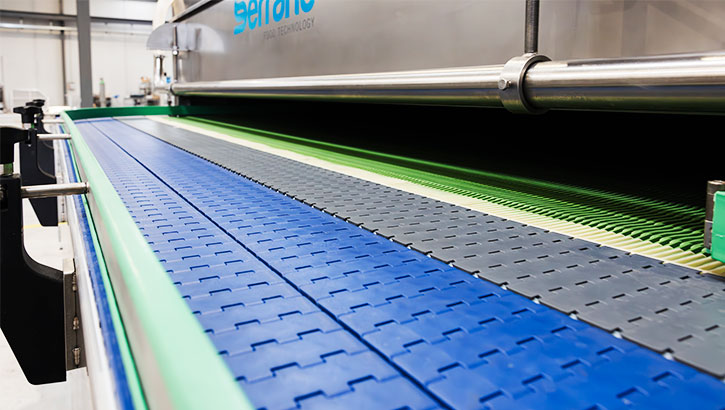
- Easy-to-clean conveyor belts
- Minimization of accumulation zones
- Speed control and synchronization between equipment units
Improper transport design can contaminate even properly sanitized lines.
Traceability and in-line sensors
The digitization of processes makes it possible to detect and prevent cross-contamination:
- Residual product presence sensors
- Flow rate and viscosity control
- Vision systems for residue detection
- Automatic batch and cleaning logging
This allows for a reaction before the problem reaches the final product.
Automation and reduction of human error
Manual intervention is one of the main sources of cross-contamination. That is why automation plays a key role:
- Less direct product handling
- Repeatable and standardized processes
- Reduction of errors during line changeovers
- Integration of automated hygiene controls