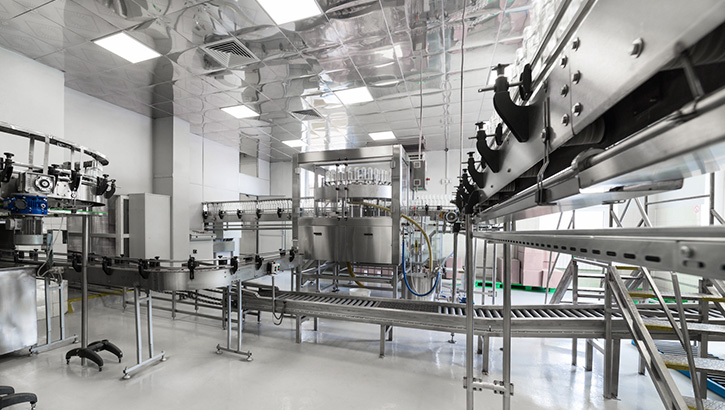
Setting up a new production line is one of the most important decisions a food company can make. A great deal is at stake: the investment, lead times, product quality and the ability to respond to customers. That is why more and more companies are choosing turnkey projects in the food industry, where a single supplier handles the entire process, from the initial idea until the line is running at full capacity.
In this article, we explain how a production line is planned from scratch, the stages involved in this type of project and the key aspects to consider so that the investment delivers the expected results.
What is a turnkey project in the food industry?
A turnkey project is one in which the manufacturer takes responsibility for the design, manufacture, installation and commissioning of the complete line. The customer receives a facility that is ready to produce: all they have to do is “turn the key”.
Compared with buying individual machines from different suppliers and coordinating them in-house, this model reduces risk, simplifies project management and ensures that all the equipment works as a single system.
The advantages of entrusting the complete line to a single manufacturer
- A single point of contact. One company is accountable for the entire project, so responsibilities are not spread across different suppliers.
- Equipment designed to work together. Capacities, working heights, speeds and control systems are defined in a coordinated way, with no bottlenecks between machines.
- More predictable lead times. Design, manufacturing and installation are planned within the same schedule.
- A single after-sales service. Maintenance, spare parts and future upgrades are handled by the team that has known the line from the very beginning.
At Serrano Foodtech, we manufacture all the equipment that makes up our complete lines, from raw material reception to palletizing. This allows us to control every detail of the project.
The 6 stages of planning a new production line
1. Needs assessment and feasibility study
Everything starts with a thorough understanding of the customer’s business. Before a single machine is drawn, questions such as these need to be answered:
- What product will be made and in what pack formats?
- What production capacity is needed today, and what is expected over the next few years?
- How much space is available, and what is the building like?
- What utilities are available (water, steam, compressed air, electrical power)?
- Which food safety regulations and certifications must the product comply with?
- What are the budget and the target timeline?
With this information, the project scope is defined and its technical and economic feasibility is assessed. This is the stage that has the greatest influence on the final outcome: a line that is correctly sized from the start avoids costly expansions later on.
2. Line design and engineering
Based on these requirements, the engineering team defines the complete process: the stages the line will include (washing, grading, peeling, blanching, filling, heat treatment, packaging, palletizing, etc.), the equipment involved in each one and how they are connected.
At this stage, the plant layout is drawn up with a logical product flow, operator safety and access for cleaning and maintenance in mind. Good design also helps to make the most of the available floor space and to minimize the risk of cross-contamination.
Drawings and 3D renderings allow the customer to visualize the facility before it is built and to request changes while they still have no cost. The level of automation and the line’s control systems are also defined at this point.
3. Equipment manufacturing
Once the design has been approved, manufacturing begins. At our facilities in Lorquí (Murcia, Spain), we build each piece of equipment to order, using food-grade materials and applying the same quality standards we follow in all our processes.
Manufacturing the entire line in one place ensures that the equipment fits together properly and that any adjustments are made in the workshop rather than at the customer’s plant.
4. Transport, assembly and installation
The equipment is transported to the customer’s plant, where the technical team carries out the mechanical assembly, the electrical and pneumatic connections and the integration with the plant’s utilities. To keep this stage on schedule, it is essential to coordinate it with the civil works and the other installations in the building.
5. Commissioning and fine-tuning
With the line assembled, the moment of truth arrives. First, dry runs are carried out to check that each piece of equipment works correctly. Then the line is tested with real product, the process parameters (temperatures, times, speeds and dosing) are adjusted, and it is verified that the line reaches the capacity and quality defined in the project.
6. Staff training and after-sales support
A production line only performs at its best when the people who run it know it well. That is why training for operators and maintenance staff is part of the project: equipment operation, cleaning, format changeovers and troubleshooting.
The relationship does not end at handover. A preventive maintenance plan and responsive technical support extend the service life of the equipment and prevent unplanned downtime.
Una línea bien dimensionada desde el principio evita ampliaciones costosas más adelante.
Common mistakes when planning a production line
- Sizing the line for current production only. If growth is not taken into account, the line will soon fall short. Modular machinery makes it possible to expand or adapt the facility without major investment.
- Overlooking utilities. Insufficient steam, water, compressed air or electrical power can delay commissioning.
- Not planning for cleaning and maintenance. A layout without proper access makes hygiene more difficult and extends downtime.
- Leaving training until the end. Staff should be involved from commissioning onwards so the line can be used to its full potential from day one.
- Looking only at the purchase price. Energy consumption, maintenance and productivity carry more weight over the lifetime of the line. Find out more about energy efficiency in industrial machinery.
SITECH: the system behind every project
All these stages are supported by SITECH, our Comprehensive Service of Technological Implementation. It is the way of working that allows us to support customers before, during and after the project, even before they start operating, with a multidisciplinary team that has known the food industry since 1978.
Frequently asked questions about turnkey projects
How long does a turnkey project take?
The timeline depends on the size of the line, the number of machines, the level of automation and the condition of the building. Careful planning in the early stages is the best way to shorten the overall timeline.
Can a turnkey project be used to upgrade an existing plant?
Yes. The same approach applies to upgrading or expanding a line: the existing facility is assessed, a decision is made on which equipment can be kept and which should be replaced, and the changeover is planned to keep production downtime to a minimum.
What products can complete lines be designed for?
We design lines for processing vegetables, fruits and legumes, and for producing sauces and creams, among other products.
What information do I need to request a project?
All you need to know is the product you want to make, the desired production capacity and the space available. From there, our team will help you define the rest.